Hip Labral Tears and Hip Arthroscopy
What a labral tear on an MRI does and does not prove, what the evidence shows about hip arthroscopy, and why some of these hips turn out to be an arthritis problem.
The short answer
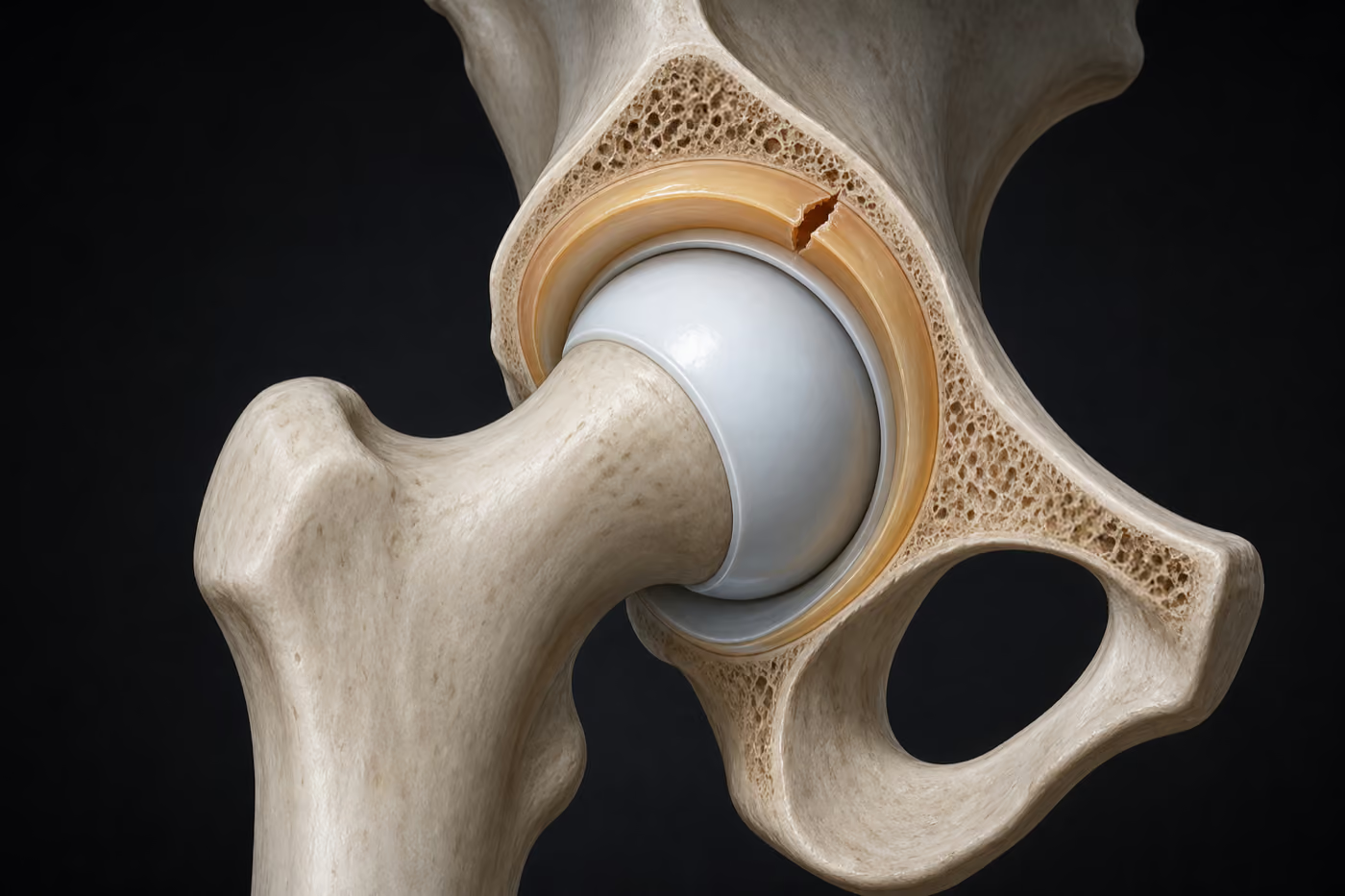
A labral tear is a tear of the cartilage rim around the hip socket, and it is one of the most misread findings in orthopedics. Dr. Patel evaluates hip pain and labral tears; he does not perform hip arthroscopy, and refers patients to a hip arthroscopist when that is the right operation.
What Dr. Patel does and does not do here
This page is about an operation Dr. Patel does not perform. He is a hip and knee replacement surgeon, and hip arthroscopy is a different specialty within orthopedics.
He is glad to see these patients anyway, for a specific reason: the indications for hip arthroscopy are narrow, the diagnosis is frequently the hard part, and some patients who arrive with a labral tear on a report turn out to have a hip problem that replacement addresses well. When a hip genuinely needs arthroscopy, the honest answer is a referral to a surgeon who performs it, and he will say so.
Why the scan alone cannot settle it
A blinded study in the American Journal of Sports Medicine imaged 45 volunteers who had never had hip pain, symptoms, injury, or surgery. Three musculoskeletal radiologists read the scans mixed in with scans from symptomatic patients. Labral tears turned up in 69% of those hips.
The plain reading: labral tears are common in hips that have never hurt. Finding one on your MRI does not establish that it is the source of your pain.
What answers that question is the examination, the history, and the pattern of what hurts and when. Sometimes an injection that numbs the joint helps settle it.
What the randomized evidence shows
The largest randomized trial of hip arthroscopy is UK FASHIoN, published in The Lancet. It assigned 348 patients with impingement syndrome and no arthritis to either hip arthroscopy or a supervised physiotherapy programme, across 23 hospitals.
At one year the arthroscopy group scored 6.8 points higher on a 100-point hip quality-of-life questionnaire. That edged past the trial’s own threshold for a difference patients notice, which was 6.1 points. It is a real difference and a modest one, and both groups improved substantially.
Arthroscopy is surgery, and it carries the risks surgery carries: infection, blood clots, nerve irritation, stiffness, and the possibility that the pain remains. In the trial, reported side effects were more common after surgery, in 72% of the arthroscopy group against 60% of the therapy group. For the right patient it helps. The evidence does not support treating it as a routine answer to hip pain.
When the answer turns out to be arthritis
Some patients referred for a labral tear have early or established arthritis driving the pain. That distinction matters, because arthroscopy performed on an arthritic hip tends to disappoint, while hip replacement is a reliable operation for arthritis that has stopped responding to other care.
Neither answer is assumed at the first visit. The point of the evaluation is to find out which problem you actually have, and that includes the possibility that the answer is neither operation: therapy, activity change, and time resolve a good number of these hips. If the answer is arthroscopy, you will be pointed to someone who does it.
Common questions
Does Dr. Patel perform hip arthroscopy?
No. He evaluates hip pain and labral tears, and refers patients to a hip arthroscopy specialist when that is the operation the hip needs. He performs hip replacement, which is a different operation for a different problem.
Does a labral tear on my MRI mean I need surgery?
Not on its own. In a blinded study of 45 people who had never had hip pain, labral tears were found in 69% of hips. The finding is common in hips that feel fine, so it has to be matched to your symptoms and examination before it means anything.
Why would a replacement surgeon see me for a labral tear?
Because the diagnosis is the difficult part. Some hips sent for a labral tear turn out to have arthritis, which is treated differently and which he treats. Sorting out which problem you have is the purpose of the visit, and a referral follows if arthroscopy is the answer.
Use the consultation to make the decision clearer.
- Is the labral tear on my scan actually the source of my pain?
- Do I have arthritis in this hip, and how much?
- Would a numbing injection help identify where the pain is coming from?
- Is a course of physical therapy a reasonable first step for me?
- If I need hip arthroscopy, who would you refer me to?
Sources and further reading
- Hip ArthroscopyAmerican Academy of Orthopaedic Surgeons
- Hip arthroscopy versus best conservative care for femoroacetabular impingement syndrome (UK FASHIoN): a multicentre randomised controlled trialThe Lancet (Griffin et al., 2018)
- Prevalence of abnormal hip findings in asymptomatic participants: a prospective, blinded studyAmerican Journal of Sports Medicine (Register et al., 2012)