Hip · Insights
What does the anterior approach actually change in a hip replacement?
The anterior approach is the direction the surgeon reaches the hip from. What the studies found, in plain numbers, and which hips it does not suit.
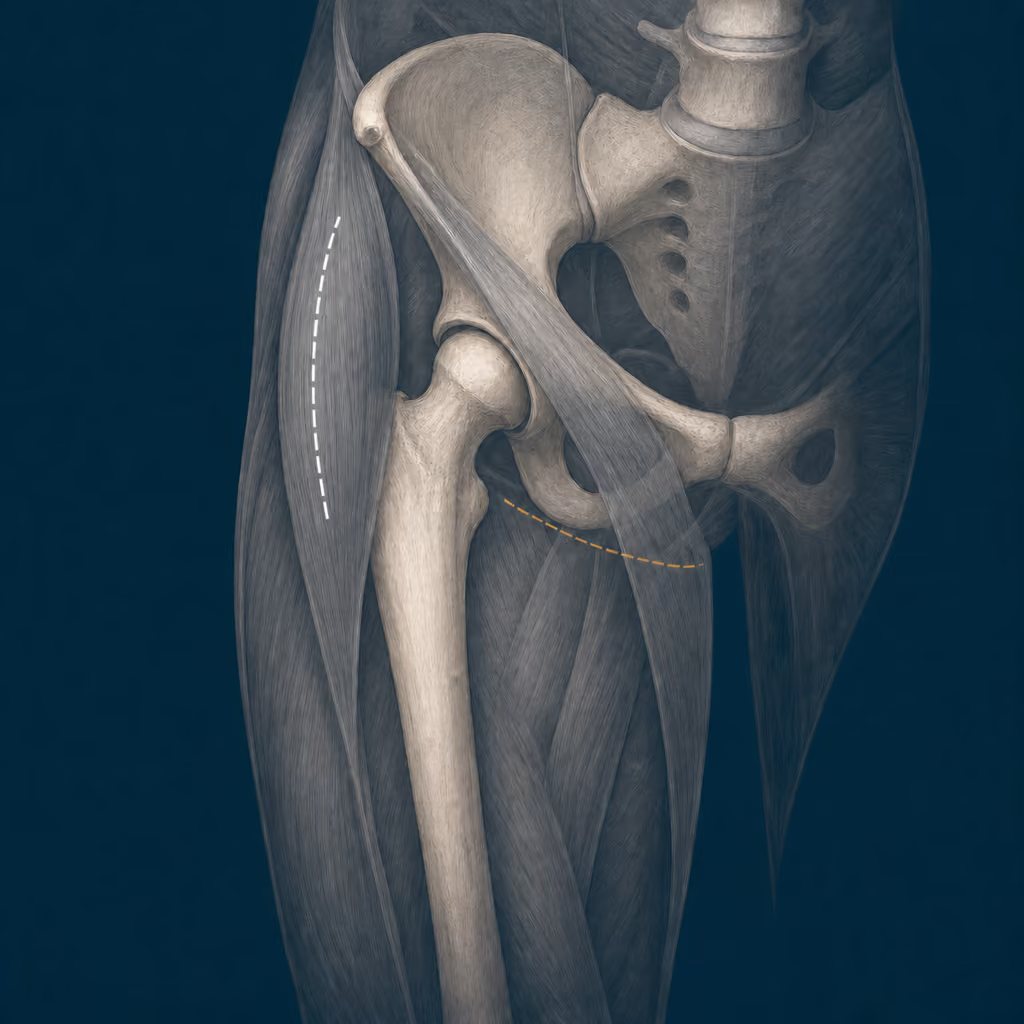
It changes the direction the surgeon comes from. That is the whole answer.
Your hip sits deep in the body. However the surgeon reaches it, muscle is in the way. The anterior approach goes in at the front, through a natural gap between two muscles. The muscles get moved apart instead of cut. Approaches from the back or the side pass through muscle and tendon, which is then repaired before closing.
That is a real difference. It is also the only difference. The same worn joint comes out, the same implants go in, and the same risks apply either way.
What do the studies actually show?
Small early differences that fade within months.
In 2025, researchers combined 17 randomized trials covering 1,575 patients. They compared the anterior approach against approaches from the back and the side. Three differences favored the anterior group:
- Pain on the first day was lower, by about three quarters of a point on a ten-point scale. Real on day one. Not large.
- Function at one month scored higher, by about 3 points on a 100-point scale. Most people could not feel a difference that small.
- Surgery took longer, by about 15 minutes.
That last number depends on who is operating. A 2021 review of 21 studies covering 9,738 patients tracked surgeons as they learned the anterior approach. Their operations averaged 157 minutes on the first case, 93 minutes by the thirtieth, and 80 minutes by the hundredth. Complications fell over the same stretch, from about 21 percent in the earliest cases to under 8 percent later on. A 2026 review of 35 studies and 96,605 hip replacements found the same pattern at larger scale. The approach has a real learning curve, and the extra time largely belongs to surgeons still on it. That is a practical reason to ask how long a surgeon has been using this approach, not just whether they offer it.
One difference ran the other way. Nerve injury was more common with the anterior approach. It affects feeling, not strength, and it is explained below.
Everything else came out even. No difference in blood loss, pain at one month, function at three months, fracture, dislocation, infection, wound problems, or blood clots.
A second 2025 review looked at 11 earlier reviews of the same question. It found the same shape. Less pain on days one and two. Better function scores at two and six weeks in some of those reviews, though not all. No difference at six months or twelve months.
How good is this research?
Not very good, and that matters.
The researchers behind that second review did something unusual. They formally graded the quality of the 11 reviews they were examining. Nine came out as critically low quality. Two came out as low quality. None rated higher.
So this is a subject with a great deal published about it and not much reliable science behind it. That is a real reason to hold all of these numbers loosely, including the ones that favor the anterior approach.
What does the approach not change?
Your result a year from now.
Every measured difference in pain and function has disappeared by six months. The numbness described below is the one thing that can outlast that, and it affects sensation rather than how the hip works. What decides how your hip feels after that is not the direction of the incision. It is whether the implants sit where they should, whether your leg lengths came out even, how the soft tissues were handled, your health going in, and the work you put into recovery.
The approach is a technical choice inside a much larger operation.
What is the numbness on the outer thigh?
A small skin nerve runs across the front of the hip, close to the anterior incision. It carries feeling from the outer thigh and sends no signal to any muscle. If it is irritated, strength and walking are not affected. What some patients notice is a patch of numbness or tingling on the outside of the thigh. It often fades over months, and sometimes it stays.
The trials counted this more often after the anterior approach, though they did not report how common it is. It is a known trade of this approach, so it belongs in the conversation before surgery rather than after.
Does the anterior approach cause more wound problems?
The evidence disagrees with itself here, and it is worth seeing why.
The pooled trials found no difference. But a large study from Mayo Clinic reviewed 17,111 hip replacements performed between 2010 and 2023. It found wound problems in the first 90 days in 3.6 percent of anterior cases and 2.6 percent of the others. In plain terms, about one extra patient in every hundred.
Both findings can be true. Wound problems are uncommon, and 1,575 patients spread across 17 trials is too small a group to spot a one-in-a-hundred difference. Seventeen thousand patients is large enough to see it. What that larger study gains in size it gives up in rigor, because patients were not assigned randomly and surgeons chose the approach themselves.
The most useful finding in that study had nothing to do with the comparison. Body weight predicted wound problems no matter which approach was used. Risk climbed most sharply above a body mass index of 33. That finding rests on all 17,111 patients, which makes it the sturdiest number here.
A 2022 review points the same way on deep infection, which the Mayo study did not measure. A higher body mass index raises infection risk with every approach. Above a body mass index of 35, the anterior approach may carry more of it. That review does not report how many patients it covered, so read it as a direction rather than a measurement.
None of this means heavier patients should not have hip replacements. It means the approach question and your own health cannot be separated. A surgeon who answers the first without looking hard at the second is answering the wrong question.
When is the anterior approach the wrong choice?
When the space at the front of the hip is too tight to work through safely.
The front is a narrower corridor than the back. Insisting on it in the wrong hip is a liability rather than a technique. These are the situations that call for a different route:
- More soft tissue at the front of the hip and lower abdomen. More tissue means less visibility, and a skin fold may sit over the incision.
- A very muscular build. Muscle narrows the same corridor from a different direction.
- Certain bone shapes and deformities, where the thigh bone cannot be moved into position safely from the front.
- Previous surgery, or metal hardware still in place. Scarring can erase the natural gap this approach depends on.
- Hips needing extensive rebuilding. Here the view matters far more than where the scar sits.
None of these is an absolute rule. They are relative: each one makes the front of the hip harder to work through, and where “harder” becomes “wrong” depends on the surgeon’s experience with the approach. A hip that is off the table for a surgeon early in the learning curve may be routine for one who has used the approach across a wide range of cases. Dr. Patel uses the anterior approach for complex and revision hip cases as well as routine ones, and he teaches anterior femoral revision as faculty at the Park City Hip & Knee Symposium. That range is part of what you are choosing when you choose a surgeon, and it is fair to ask about it directly.
When the answer is still no, an approach from the back or the side is not second best. It is the right operation. A surgeon who cannot say so plainly is not really offering you a choice.
The plan can also change during surgery. If the view is not good enough, switching approaches or lengthening the incision is good judgment, not a complication.
How is the bikini incision different?
Only the skin. Underneath, it is the same anterior approach.
A standard anterior incision runs lengthwise down the front of the thigh. The bikini version is shorter and lower, angled to follow the natural crease at the groin, so the scar tends to sit inside a skin fold.
A 2026 review pooled 8 studies covering 2,017 hips. Patients rated the appearance of the bikini scar better, and it did not add time to the operation. On nerve injury, the overall result showed no clear difference. But when the researchers looked only at the strongest randomized trials, the bikini group had about twice the risk. The authors’ conclusion was direct: this technique suits surgeons well past the learning curve for anterior hip replacement.
That is a fair summary of the trade. A better-hidden scar is a reasonable thing to want. It is not free.
More on that comparison: bikini incision vs. standard anterior hip replacement.
Where this fits in Dr. Patel’s practice
The anterior approach is Dr. Patel’s routine route for hip replacement. The bikini-incision version is offered to selected patients. He also performs approaches from the back and the side, and recommends them when the hip in front of him calls for it.
The same thinking runs through the knee side of his practice, which is where the subvastus approach comes from. Where the anatomy allows it, work around muscle rather than through it. The important word is “allows.” On the knee side it is a selective choice, used in some knees and not others, for the same reasons about space and visibility described above.
None of this settles whether you need a hip replacement at all. That question comes first. Hip arthritis covers the non-surgical options that stay open even when the X-ray looks bad.
Worth asking at the visit
- Looking at my imaging and my build, does the anterior approach give you the view you want, or would you choose differently for me?
- How long have you been using the anterior approach, and do you use it for complex or revision hips as well?
- What would make you switch to another approach during surgery?
- How often do your patients notice numbness on the outer thigh, and does it usually go away?
- Does my weight change your thinking about which approach to use?
- What in my recovery plan comes from the approach, and what comes from anesthesia, pain control, and therapy?
The anterior hip replacement page covers how the approach is performed and how candidacy is decided.
Sources
- Total Hip ReplacementAmerican Academy of Orthopaedic Surgeons
- Total Hip ReplacementAmerican Association of Hip and Knee Surgeons
- Comparative efficacy of direct anterior approach versus conventional surgical approaches in total hip arthroplasty: a systematic review and meta-analysis of randomized clinical trialsJournal of Orthopaedic Surgery and Research (2025). 17 randomized trials, 1,575 patients. Day-1 pain lower by 0.79 points (95% CI 0.59 to 1.00); Harris Hip Score at 1 month higher by 3.41 (95% CI 0.29 to 6.53); operative time 14.5 min longer; nerve injury relative risk 7.37 (95% CI 2.52 to 21.51).
- Direct Anterior Approach and Posterior Approach for Total Hip Arthroplasty: A Systematic Umbrella Review of Meta-Analyses of Randomized Controlled TrialsOrthopedic Reviews (2025). Reviewed 11 prior reviews with the AMSTAR-2 quality tool: 2 rated low quality, 9 rated critically low.
- Surgical Approach and Body Mass Index Impact Risk of Wound Complications Following Total Hip ArthroplastyThe Journal of Arthroplasty (2024). Multicenter, 17,111 hip replacements. 90-day wound complications 3.6% vs 2.6%, adjusted odds ratio 1.5. Body mass index cut-point 33.
- Does Surgical Approach for Total Hip Arthroplasty Impact Infection Risk in the Obese Patient? A Systematic ReviewOrthopedics (2022). Systematic review; no pooled patient total reported.
- The learning curve for the direct anterior total hip arthroplasty: a systematic reviewInternational Orthopaedics (2021). Systematic review, 21 studies, 9,738 patients. Mean operative time 157 minutes for a surgeon's first case, 93 minutes by case 30, 80 minutes by case 100; complication rate 20.8% in early groups versus 7.6% in late groups.
- Lessons from the learning curve of the direct anterior approach in total hip arthroplasty: a systematic reviewMusculoskeletal Surgery (2026). Systematic review, 35 studies, 96,605 primary hip replacements. Complication prevalence during the learning phase 2.75%; reoperation 1.81%.
- Oblique Bikini Incision Versus Longitudinal Incision for Direct Anterior Approach Total Hip Arthroplasty: A Systematic Review and Meta-AnalysisHealth Science Reports (2026). 8 studies, 2,017 hips. Scar appearance standardized mean difference 0.62 favoring the bikini incision; nerve injury overall odds ratio 1.19 (not significant), randomized-trial subgroup odds ratio 2.15 (95% CI 1.26 to 3.68).
This article is education, not medical advice, and does not describe your specific situation. Bring your questions to a consultation.
Reviewed at least annually, and whenever major clinical guidance, source references, or practice facts change.
How this was written: the question, the argument, and the final call on every sentence are mine. I use AI as a drafting and research partner, because it is a better writer than I am. I bring the idea and the position, it produces drafts, and I edit until the piece says what I mean. That process is why a detector may flag this piece as machine-written. The judgment and the responsibility for what is on the page are mine.